Re-Stucco Services in Tucson, AZ
Complete exterior stucco replacement for Tucson homes and commercial properties. Three-coat systems, EIFS conversion, and historic plaster replacement across Pima County.
When Patching Is No Longer Enough
Most stucco damage on Tucson homes is patchable. Isolated cracks, small hollow sections, and localized water staining are repair jobs, not replacement jobs. But there are clear thresholds where patching stops making sense, and trying to patch past those thresholds usually ends in a second call to a contractor within a few monsoon seasons.
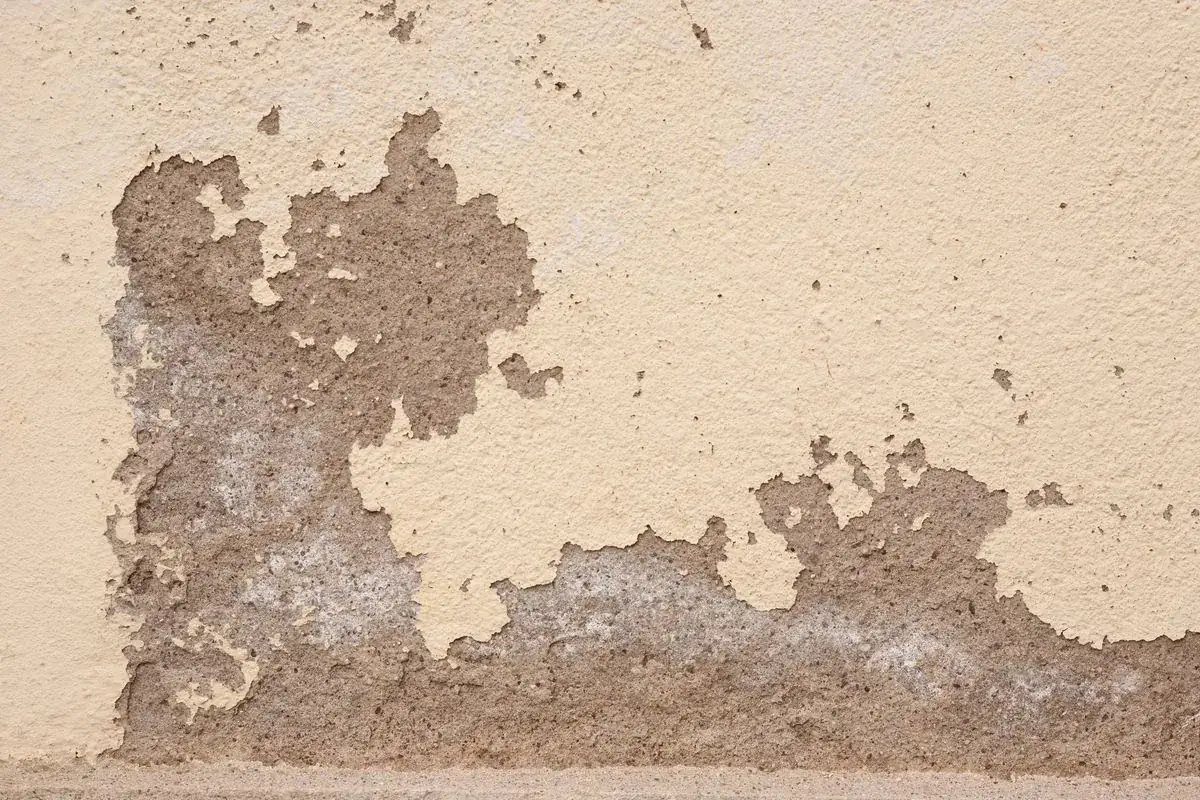
Full re-stucco makes sense when delamination covers 30 percent or more of a wall face. At that coverage level, a patch job becomes more labor-intensive than a full replacement, the visual result is inconsistent, and the remaining bonded stucco is usually close to the same point of failure anyway. Complete replacement is also the call when water has worked its way to the substrate: soft spots when you press on the wall, staining that tracks upward from a crack, or mold growth at the base of a wall are all signs the moisture has been in there a while.
The other scenario where re-stucco is the right call is texture matching. Tucson stucco weathers significantly over decades, and the color coat fades unevenly under intense UV. When repairs cover a large enough area, matching the original surface becomes impractical. A full re-stucco removes the problem and gives you a consistent exterior from corner to corner.
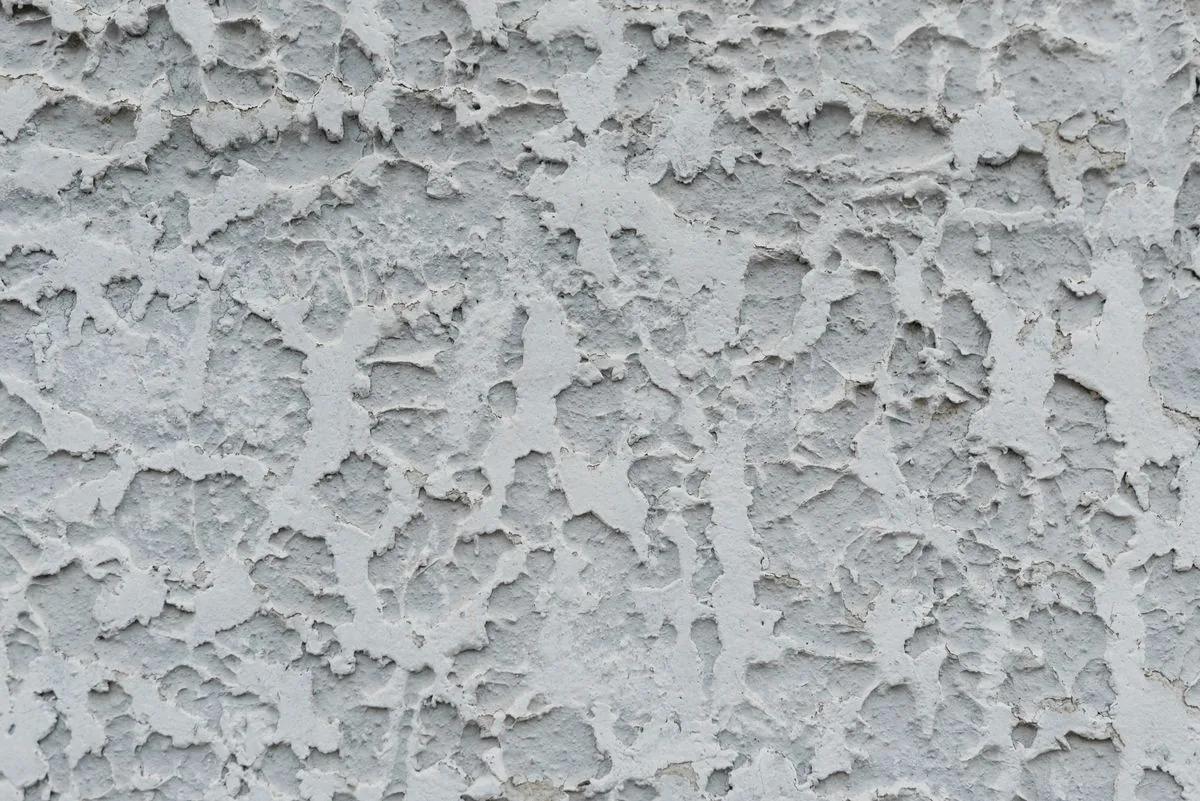
Widespread delamination like this exceeds the repair threshold. Re-stucco is the better investment.
Tucson Homes That Commonly Need Re-Stucco
The highest volume of full re-stucco work in Tucson comes from three property types. First, 1970s through 1990s homes that were originally finished with a one-coat system. One-coat stucco (roughly 3/8 to 1/2 inch thick, versus about 7/8 inch for three-coat) was the dominant residential application during Tucson's boom years, and the earliest of those installations are now 40 to 50 years old. The one-coat system is thinner than three-coat and more susceptible to cracking as the substrate moves over time. Many of these homes have had patches on top of patches for years and have reached the point where replacement is the cleaner answer.
Second, EIFS installations that have failed. EIFS (exterior insulation and finish systems, sometimes called synthetic stucco) was popular on Tucson commercial and higher-end residential construction through the 1990s and early 2000s. When EIFS fails, and it often fails at penetrations, window heads, and base terminations, it traps water behind the foam board where it stays against the sheathing. By the time the problem is visible on the surface, the substrate is often damaged. Remediation is a full tear-off and restart, not a patch.
Third, historic adobe homes with deteriorated lime plaster layers. Tucson's adobe building stock carries plaster applications that are sometimes a century old. When lime plaster fails, it often fails in layers: the finish coat delaminating from the brown coat, or the whole plaster system releasing from the adobe block. These projects require a different material approach than modern Portland cement stucco, and the options are traditional lime plaster restoration or conversion to a compatible modern system. See historic stucco restoration for how an old mix is matched.
Stucco Systems for a Re-Stucco
1" total thickness. Scratch, brown, and finish coats over metal lath. Best long-term moisture resistance for Pima County's monsoon climate.
Single application over fiberglass mesh. Faster install. Code-compliant for Pima County. Common on re-sides where the substrate is in good condition.
New foam board, base coat, reinforcing mesh, and finish coat. Can stay as EIFS or convert to hard-coat depending on preference and wall assembly.
Engineered acrylic finish systems for commercial applications. Better crack resistance and color retention than traditional Portland cement finish coats.
The Re-Stucco Process, Step by Step
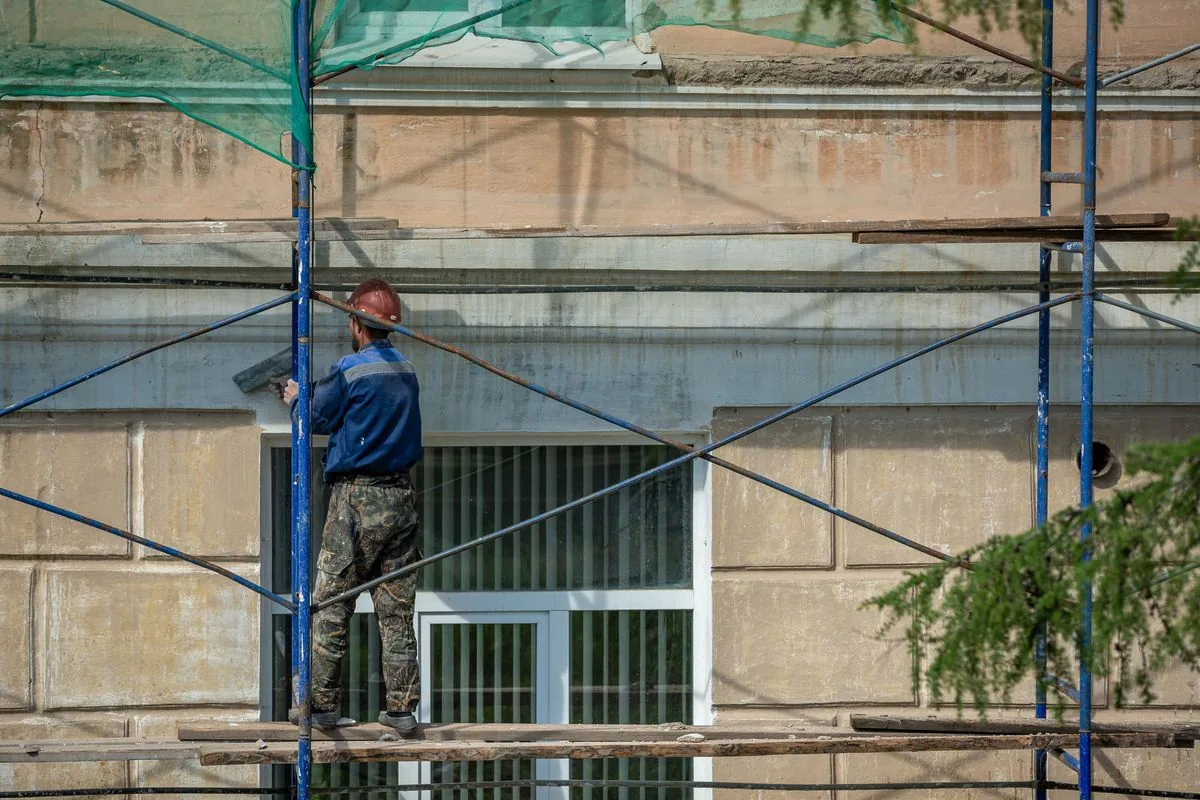
Full re-stucco is not a quick job, and any contractor who tells you otherwise is cutting corners on curing time. Here is what happens on a properly executed re-stucco project in Tucson.
All existing stucco is removed down to the metal lath or wood sheathing, depending on the original wall assembly. New material should never go over failing stucco.
Once the wall is stripped, the sheathing, framing, and lath are inspected for moisture damage, rot, or structural issues. Any compromised material is replaced before the new system goes on.
New moisture-resistant barrier is installed per current Pima County code. Metal lath is fastened to the substrate to give the scratch coat a mechanical key to grip.
The first coat is applied at approximately 3/8-inch thickness and scored horizontally to create bonding texture for the brown coat. It cures a minimum of 48 hours before the next coat.
The brown coat brings the wall to a flat, level plane at roughly 3/8-inch thickness. It cures fully before the finish coat is applied. This curing window cannot be rushed in Tucson's summer heat without weakening the bond.
The finish coat establishes your chosen texture: smooth, sand finish, dash, or skip trowel. A matching color coat is applied over the finish for a fully integrated exterior color throughout the stucco thickness.
Timeline and Pricing in Tucson
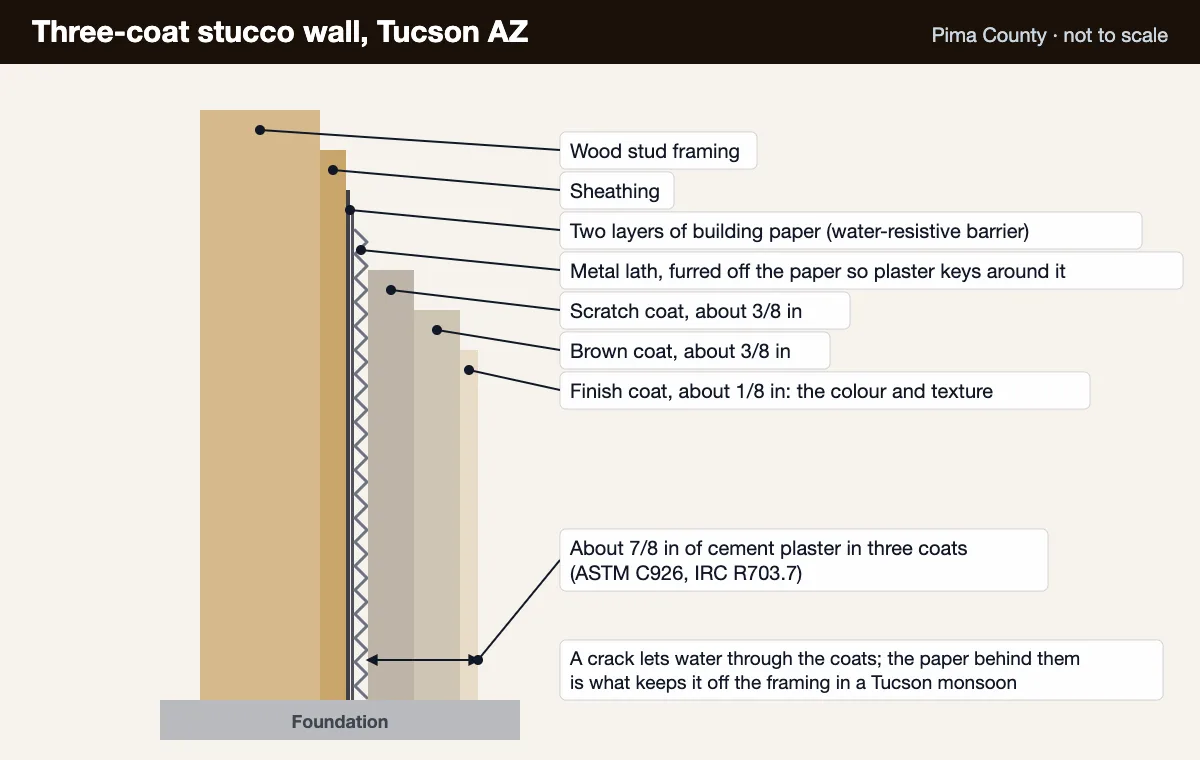
A typical single-story Tucson home takes 5 to 10 days from demo through final color coat. That window accounts for the required curing time between coats: the scratch coat needs a minimum of 48 hours before the brown coat goes on, and the brown coat needs to cure fully before the finish coat is applied. In Tucson's summer heat (above 95 degrees F), evaporation accelerates and the coats may need wet-curing to ensure proper hydration, which adds to the schedule. The curing window should never be rushed. Compressed timelines between coats are the primary reason re-stucco jobs crack again within the first or second monsoon season.
For pricing, a complete exterior re-stucco on a typical single-story Tucson home runs $8,000 to $12,000. That includes full demo of the existing system, substrate inspection, any sheathing or lath repair needed, and the full three-coat application with color coat. Two-story homes and larger square footages are typically $15,000 to $25,000 or more depending on complexity, accessibility, and whether the scope includes EIFS removal, historic lime plaster, or significant sheathing replacement.
Those are starting ranges. The real number for a specific home depends on measured wall area, how much sheathing or lath turns up damaged once the old stucco is off, and access.
Adding stucco where there was none (a new addition, a casita, or a block wall that was never coated) is a different job from replacing failing stucco; see stucco installation in Tucson. If the walls are sound and only faded, a stucco painting or fog coat costs far less than re-stucco.
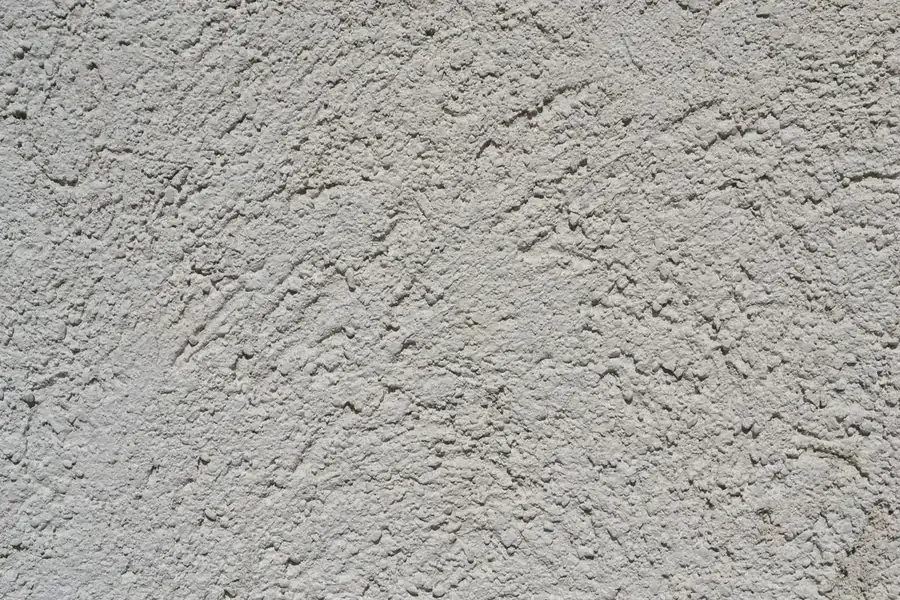
Finished three-coat stucco. Color runs throughout the finish coat, not painted over the top.
Timing Your Re-Stucco Project in Tucson
The ideal window for a full re-stucco in Tucson is October through May. Temperatures in that range allow proper curing without forced hydration and without the moisture interference of monsoon season (June 15 through September 30). Re-stucco projects do get scheduled in summer: the heat is manageable and curing time between coats can actually accelerate slightly in dry heat. What to avoid is monsoon season, specifically the period when afternoon thunderstorms can deliver rain before a freshly applied coat has set. A newly applied scratch coat or brown coat that gets rained on within the first 24 hours can lose adhesion and have to come off.
If your project is urgent, it can be worked around the monsoon schedule with careful timing and tarp staging on critical coats. Just go in knowing the risk if you push through summer: the season does matter.
Have the square footage, the number of stories and the age of the current stucco ready when you call.
Call (520) 224-9128- Tucson, AZ
- Oro Valley, AZ
- Marana, AZ
- Sahuarita, AZ
- Green Valley, AZ
- Catalina Foothills, AZ
- Casas Adobes, AZ
- Vail, AZ
Serving all of Pima County. Call to confirm availability for your address.
Re-Stucco Tucson AZ: Frequently Asked Questions
How do I know if my home needs a full re-stucco or just patches?
What stucco system will you use on my home?
How long does a full re-stucco take in Tucson?
What does full re-stucco cost in Tucson?
Do you handle EIFS removal and replacement in Tucson?
Tucson and Pima County. No obligation to ask.