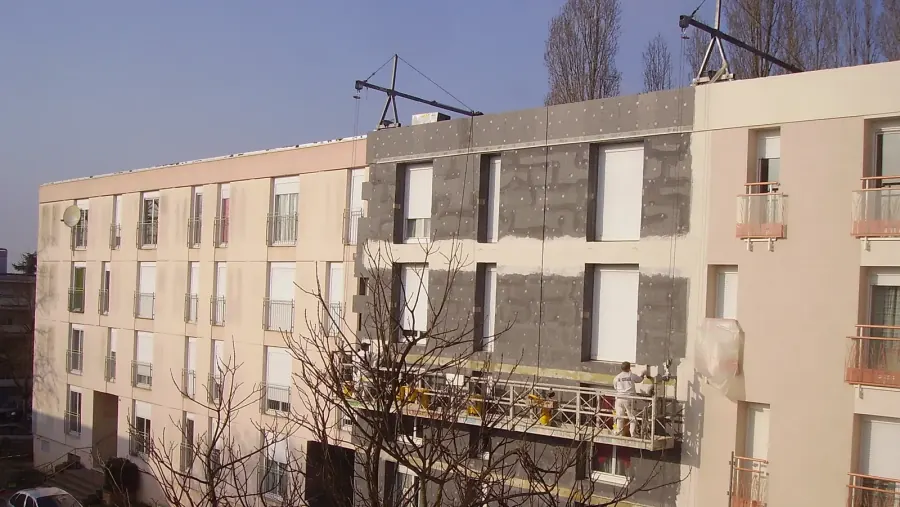
EIFS vs Stucco Cost in Tucson, AZ
What each system actually costs per square foot in the Tucson market, what a real house works out to, and what the 30-year number looks like once maintenance is counted.
EIFS costs $8 to $14 per square foot installed in Tucson, while traditional three-coat stucco costs $7 to $9 per square foot. That makes EIFS roughly 15 to 35 percent more expensive up front. On a 2,000 square foot single-story Tucson home, which has about 1,400 square feet of net wall area, that works out to about $11,200 to $19,600 for EIFS against $9,800 to $12,600 for traditional stucco.
The install price is only part of the picture. EIFS repairs run 20 to 40 percent higher than equivalent traditional stucco repairs, and the acrylic finish needs recoating every 8 to 12 years under Tucson sun versus 10 to 15 years for a cement finish. Over a 30-year hold, a traditional stucco wall typically totals about $14,000 to $25,000 while EIFS totals about $23,000 to $40,000 before any energy saving is applied.
EIFS vs Stucco Cost Per Square Foot
Traditional three-coat stucco prices at $7 to $9 per square foot installed in the Tucson market, and EIFS prices at $8 to $14 per square foot for comparable residential work. Those are the numbers to budget against. Arizona sits modestly below national pricing because construction labor in the state runs about 9 percent under the national average, and the statewide stucco range of $5 to $13 per square foot reflects everything from a plain single-story tract home at the bottom to custom architectural work at the top.
You will also see much wider EIFS figures quoted nationally, as broad as $8 to $45 per square foot with an average near $16. That range is not wrong, it is just measuring a different population. The high numbers come from commercial curtain wall retrofits, thick foam assemblies specified to hit an energy code target, and elevations loaded with shaped foam banding and cornice profiles. A normal Tucson house does not land there. Use the $8 to $14 band for residential planning and treat anything above it as a signal to ask the contractor exactly what is driving the premium.
One number deserves particular attention because it is where most homeowners misjudge the comparison: the labor share. Traditional stucco labor runs about $1 to $3 per square foot. EIFS labor runs about $2 to $5. The extra money buys board layout, adhesive or mechanical fastening, rasping the foam flat, embedding mesh in a wet basecoat, and waiting for cure between passes. Those are real steps, not markup, and they are the reason the gap does not close when material prices move.
| Factor | Traditional Stucco | EIFS | Notes |
|---|---|---|---|
| Installed cost per sq ft | $7 to $9 | $8 to $14 | Tucson residential; AZ labor runs about 9% under the national rate |
| Wide market range | $5 to $13 | $8 to $45 | Upper end reflects complex commercial and custom architectural work |
| Labor share of install | $1 to $3 per sq ft | $2 to $5 per sq ft | EIFS adds board layout, fastening, mesh embedment and cure waits |
| Cost premium vs traditional | Baseline | 15% to 35% higher | Before any energy saving is counted |
| Typical repair cost | Baseline | 20% to 40% higher | Acrylic-compatible materials plus specialist labor |
| Refinish interval in Tucson | 10 to 15 years | 8 to 12 years | Sonoran UV degrades acrylic faster than mineral finishes |
| Insulation value added | None (about R-0.2) | R-2 to R-7 | Depends on EPS foam thickness specified |
| Service life with maintenance | 50+ years | 25 to 40 years | EIFS life is far more sensitive to installation quality |
| Impact resistance | High, will not dent | Low, dents from trimmers and ladders | Every EIFS dent is a potential water entry point |
| Monsoon moisture tolerance | Breathable, dries out | Barrier system, traps water if breached | Drainage-plane EIFS mitigates this; barrier EIFS does not |
| Insurance friction | None | Exclusions and surcharges are common | Confirm with your carrier before committing to EIFS |
What It Costs on an Actual Tucson House
A 2,000 square foot Tucson house costs about $9,800 to $12,600 in traditional stucco or $11,200 to $19,600 in EIFS, assuming it is single story. Two stories changes the answer substantially, to about $13,650 to $17,550 traditional or $15,600 to $27,300 in EIFS. The reason the same floor area produces two very different bids is the detail almost every online cost calculator glosses over.
Stucco is sold by wall area, not floor area. When someone asks what it costs to stucco a 2,000 square foot house, the 2,000 is the number on the tax assessment, and it has almost no direct relationship to the surface a crew has to coat. A 2,000 square foot single-story home measuring roughly 50 by 40 feet has a 180 foot perimeter. At 9 foot walls that is 1,620 square feet gross, and after deducting about 15 percent for windows and doors you are coating roughly 1,400 square feet.
Stack that same 2,000 square feet over two floors and the footprint shrinks to about 32 by 32 feet, giving a 128 foot perimeter. But the walls are now 18 feet tall, so gross area rises to 2,304 square feet and net area to roughly 1,950. You are coating 40 percent more surface for the same house size, and you are paying an access premium on top of it. This is why a bid should always be quoted per square foot of wall with the measured quantity shown.
180 ft perimeter, 9 ft walls, less 15% for openings
128 ft perimeter, 18 ft walls, less 15% for openings
155 ft perimeter, 9 ft walls, less 15% for openings
170 ft perimeter, 18 ft walls, less 15% for openings
Wall areas above are estimated from typical Tucson footprints using 9 foot wall heights and a 15 percent deduction for openings. Your actual measured area will differ. We measure it as part of the free estimate.
Why EIFS Costs More Than Traditional Stucco
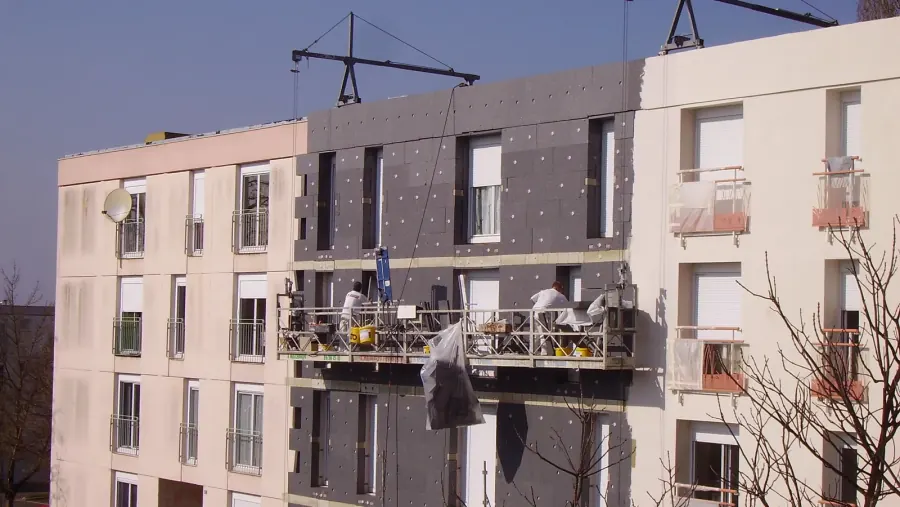
EIFS costs more because it is four operations where traditional stucco is three, and because two of those operations use materials that cost several times what Portland cement does. Traditional three-coat stucco is a scratch coat, a brown coat, and a finish coat over metal lath, all built from cement, sand, and water. EIFS is an adhesive or fastener layer, a foam board layer that has to be cut and rasped flat, a polymer basecoat with fiberglass mesh embedded wet, and an acrylic finish coat. Here is where the money actually goes.
EPS board, adhesive, and mechanical fasteners are a material line that traditional stucco simply does not have. Thickness drives both the R-value and the price, and a spec that jumps from one inch to three inches to hit an energy target adds cost across the entire wall, not just at detail areas.
Boards have to be laid out in a running bond, cut around every opening, and then rasped flat so the finished plane is true. A wavy foam substrate telegraphs straight through the thin coats above it, so this step cannot be rushed. It is pure labor with no equivalent in a traditional stucco sequence.
The fiberglass reinforcing mesh must be worked into wet polymer basecoat and lapped correctly at every seam and corner. Polymer-modified basecoat costs materially more per bag than a cement scratch mix, and the embedment has to happen inside the working time of the material, which limits how much area a crew can open at once.
Acrylic finish is substantially more expensive per square foot than a cement finish or a fog coat. It also has a narrower application window on temperature and humidity, which in Tucson means more mornings lost to heat and more schedule risk during monsoon.
Because EIFS is a barrier system, every window, door, hose bib, light fixture, and pipe penetration requires correct backwrapping and sealant detailing. Each one is a small, slow, skilled operation. On a traditional stucco wall a missed detail is a maintenance item. On EIFS it is the beginning of a foam saturation problem.
What Moves the Price in Tucson Specifically
Six factors explain almost all the spread between a low bid and a high bid on the same Tucson house. National cost articles cover the first two and skip the rest, which is why quotes so often land outside the range a homeowner was expecting. Access and architectural detail are universal. Substrate surprises, monsoon and heat scheduling, the barrier versus drainage decision, and Arizona licensing are where the local reality lives.
This is the single biggest swing factor in a Tucson bid. Anything a crew can reach from the ground or a short ladder prices at the low end of the range. Two-story walls, walls over a slope, or facades that need swing stage or lift access add 10 to 20 percent to the same square footage because setup, safety, and material handling all slow the work down. EIFS feels this more sharply than traditional stucco because the foam boards have to be laid out, fastened, and rasped flat before any coating starts.
Plain wall planes are cheap. Banding, recessed window returns, pop-outs, arches, and cornice profiles are not. On traditional stucco these details are built up in cement and cost extra labor. On EIFS they are usually shaped from separate foam profiles that must be cut, adhered, meshed, and coated individually, which is why heavily detailed EIFS jobs are the ones that reach the top of the $8 to $45 national range. A Santa Fe or Territorial elevation with deep reveals can add 15 to 30 percent over a plain box of the same square footage.
Neither system can be priced with certainty until the old surface comes off. On Tucson homes the common surprises are rusted metal lath at splash zones, deteriorated sheathing under a leaking scupper or canale, and termite damage at wall bases on the south and west elevations. Budget a contingency of 5 to 15 percent on any recladding job. If the existing wall already shows staining, efflorescence, or hollow-sounding areas when tapped, use the higher end of that contingency.
Tucson's calendar has a real cost effect. Acrylic and cementitious coatings both fail to cure correctly above roughly 95 degrees F, so summer work means early morning starts, shorter productive days, and sometimes retarders or misting, all of which raise the labor line. Monsoon season from mid-June through September introduces wash-out risk on fresh coats. October through May is the efficient window, and bids placed for that window are typically tighter than a July bid for the same scope.
If you are specifying EIFS new, this choice matters more than the foam thickness. Barrier EIFS, the older and cheaper assembly, relies entirely on a perfect surface seal. Drainage EIFS adds a water-resistive barrier and a drainage cavity behind the foam so any water that does get in has a path out. Drainage assemblies cost roughly $1 to $3 more per square foot. In a climate with high-intensity monsoon rainfall and hard wind-driven events, that is the cheapest insurance on the entire job.
Any contractor doing this work in Arizona should hold an active Registrar of Contractors license in the B-13 plastering and stucco specialty or an appropriate general classification. Licensed, bonded, and insured crews price above the unlicensed bottom of the market, and that difference is not padding. A full recladding usually requires a permit and inspection through City of Tucson PDSD or Pima County Development Services, and an unpermitted exterior can surface as a problem at resale.
The 30-Year Cost, Not Just the Install Price
Over 30 years on a typical 1,400 square foot wall, traditional stucco totals roughly $14,000 to $25,000 and EIFS totals roughly $23,000 to $40,000. The install price is where most comparisons stop, and it is the smaller part of the difference. Refinishing cycles and repair costs do more to separate the two systems than the original bid does.
The mechanism is straightforward. Acrylic finish coats fade and chalk faster than mineral finishes under Sonoran Desert UV, which pulls the EIFS refinish interval in to roughly 8 to 12 years against 10 to 15 for traditional stucco. Over a 30-year hold that is three EIFS cycles against two traditional cycles, and each EIFS cycle costs more per square foot because acrylic finish material is more expensive than a cement finish or fog coat. Repairs compound it further at 20 to 40 percent above equivalent traditional work.
| Cost line | Traditional Stucco | EIFS |
|---|---|---|
| Initial install | $9,800 to $12,600 | $11,200 to $19,600 |
| Refinish cycles over 30 years | 2 cycles, about $2,100 to $7,000 | 3 cycles, about $8,400 to $14,700 |
| Routine repair and sealant upkeep | About $2,000 to $5,000 | About $3,000 to $6,000 |
| 30-year running total | About $14,000 to $25,000 | About $23,000 to $40,000 |
| Energy saving offset | None | Reduces the gap, rarely closes it on a single-story home |
EIFS manufacturers commonly advertise a 7 to 12 year break-even on the cost premium through reduced cooling load. Treat that as a best case rather than a planning number. The calculation usually assumes the recurring costs of both systems are equal, and in Tucson they are not, because the shorter acrylic refinish cycle and the higher repair rate both work against EIFS over the same period.
Where EIFS does make a strong financial case is on buildings with a high ratio of wall area to floor area and a continuously conditioned interior. That describes Tucson commercial property well. It describes a single-story residential ranch poorly, which is the honest reason most Tucson homes are still finished in traditional stucco.
EIFS and Insurance: The Cost Nobody Quotes You
Insurance is a real and frequently overlooked line item in the EIFS decision, and it can cost more than the install premium. Many carriers surcharge, restrict, or decline EIFS-clad buildings, and EIFS exclusions are standard language in a great many commercial general liability policies. If you are weighing the two systems on price, get a quote from your carrier for both before you sign anything.
The history explains the underwriting. Early EIFS was a barrier system with no drainage path, and on wood-frame construction it trapped water inside wall cavities, producing rot, mold, and termite activity that often went undetected until the damage was structural. After a 1999 NBC Dateline segment brought the failures to national attention, claims volume rose sharply and litigation followed. Insurers responded by writing EIFS exclusions into liability policies, and a secondary concern about EPS foam and flame spread reinforced the caution.
Modern drainage EIFS is a genuinely different product. It adds a water-resistive barrier and a drainage cavity behind the foam so incidental water has a path back out of the assembly, which addresses the original failure mode directly. Underwriting practice has not fully caught up with that improvement, so the market still prices EIFS as a category rather than by assembly type. Two practical consequences for a Tucson owner: confirm coverage in writing before committing, and if you do install EIFS, specify a drainage assembly and keep the documentation.
Ask your carrier directly whether EIFS affects your premium, deductible, or eligibility. Get it in writing, not over the phone.
Keep maintenance and sealant records. A documented inspection history is the strongest response to an underwriting question.
Expect buyers to order a moisture survey. A clean survey resolves most EIFS objections quickly.
Repair Cost: Where the Gap Really Shows
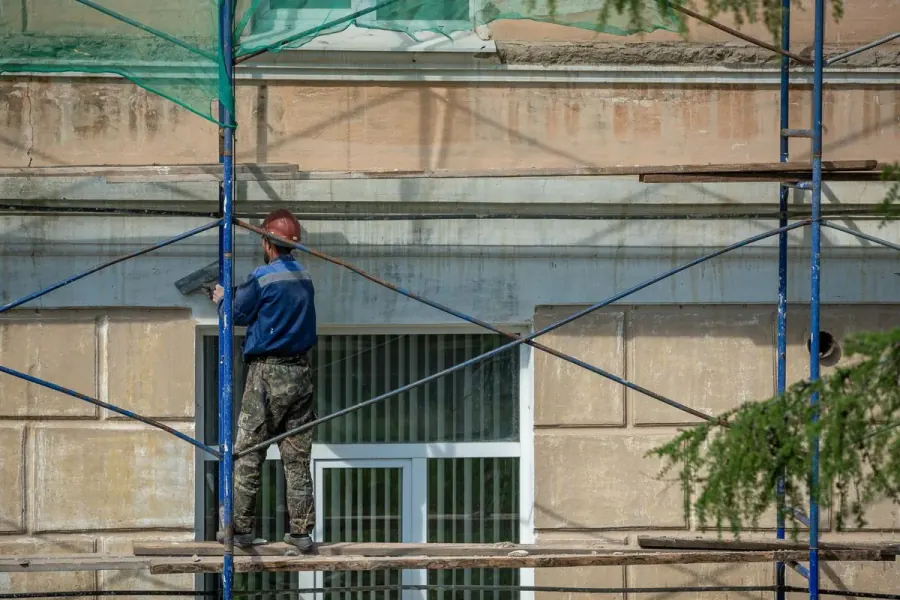
EIFS repairs run 20 to 40 percent higher than equivalent traditional stucco repairs on a per square foot basis. That is the number most homeowners feel, because almost every wall gets repaired long before it gets replaced. Three things drive the premium: EIFS-compatible acrylic materials cost more than Portland cement products, the repair has to integrate with the existing foam layer rather than simply bonding to a hard substrate, and fewer contractors are genuinely competent with the system.
Color matching is the second cost most people do not anticipate. Acrylic finish weathers differently than Portland cement, so a patch on a 10-year-old EIFS wall may not match even when the original color formula is used, because the surrounding wall has faded and the patch has not. On traditional stucco a fog coat can blend a repair into the field convincingly. On EIFS the honest fix is often to refinish a full wall plane to a control joint, which turns a small repair into a much larger scope.
There is also a diagnostic cost specific to EIFS. Because the foam holds moisture rather than shedding it, the damaged area is frequently larger than what is visible from outside, and a moisture meter survey is needed before the scope can be priced honestly. On traditional stucco, what you see is usually close to what you get. For detailed repair pricing on either system, our Tucson stucco repair cost guide breaks down every repair type by size and severity.
Press your knuckle firmly against the wall. EIFS gives slightly because there is foam behind the finish. Traditional stucco is rigid and will not move at all. We confirm the system and measure your actual wall area as part of the free estimate, and pricing either way starts from a measured number rather than a guess.
Which Should You Choose? A Decision Guide
For the large majority of Tucson homes the answer is traditional three-coat stucco, and the exceptions are specific enough to name. Match the table below to your situation rather than reasoning from the general pros and cons, because the right answer depends far more on your building type and holding period than on the systems in the abstract.
Portland cement products will not bond correctly to an EIFS surface, and acrylic EIFS materials do not belong on a cement wall. Mixing them causes adhesion failure within a few seasons. Identify the system first, then price the repair.
Lower install cost, lower repair cost, better monsoon tolerance, and a longer service life. The wall area is too small for the insulation benefit to outrun the maintenance premium.
More wall area means the insulation benefit scales up. Get an actual energy model rather than trusting a generic payback claim, and specify a drainage assembly if you go with EIFS.
Large continuously conditioned envelopes, high wall-to-floor ratios, and the ability to hit an energy code target without rebuilding the wall assembly all favor EIFS. This is why so much of Tucson's 1990s commercial stock is EIFS-clad.
EIFS can complicate financing, inspection, and insurance. Some carriers surcharge or decline EIFS-clad homes outright, and buyers increasingly order moisture surveys on them.
Adding EIFS area to a property your carrier already treats as elevated risk can affect coverage terms. Confirm in writing before signing a contract for an EIFS installation.
How to Price Your Own Job in Five Steps
You can produce a realistic budget range in under an hour with a tape measure and a calculator, and doing so before you request bids is the fastest way to tell a fair quote from a bad one. Work through these five steps in order.
- 1Measure your wall area, not your floor area
Walk the perimeter of the house and record the total distance in feet. Multiply that perimeter by the wall height, using 9 feet per story as a working figure for most Tucson construction. This gives gross wall area.
- 2Deduct windows and doors
Subtract roughly 15 percent from the gross wall area to account for window and door openings on a typical Tucson home. Homes with large glazed areas or multiple sliding doors should use 20 to 25 percent instead.
- 3Apply the per square foot range for each system
Multiply net wall area by $7 to $9 per square foot for traditional three-coat stucco, and by $8 to $14 per square foot for EIFS. This produces your baseline budget range for each system before site-specific adjustments.
- 4Adjust for Tucson-specific cost drivers
Add 10 to 20 percent for two-story or difficult access requiring lift or scaffold, for heavy architectural detail such as banding and recessed window returns, or for substrate repair discovered during tear-off. Add a contingency if the existing wall shows map cracking or staining that suggests hidden moisture.
- 5Compare the 30-year total, not just the install price
Add the expected refinishing cycles and repair costs across your ownership horizon to each install estimate. Traditional stucco recoats every 10 to 15 years, EIFS every 8 to 12 years at a higher per square foot rate, and EIFS repairs run 20 to 40 percent above equivalent traditional work.
If your own number and a contractor's bid disagree by more than about 25 percent, the difference is almost always in one of three places: the measured wall area, an access condition you did not price, or a substrate repair the contractor expects to find and you did not. Ask which one it is. A contractor who can point to the specific line is quoting honestly, and one who cannot explain the gap is worth a second opinion.
Three Things National Cost Guides Get Wrong About Tucson
Almost every calculator asks for house square footage and quietly applies an assumed multiplier. Since a two-story home has roughly 40 percent more wall than a single-story home of the same floor area, that assumption alone can move an estimate by thousands of dollars. Measure the perimeter and the wall height, then deduct the openings.
Application temperature limits are not a footnote in this climate, they are a scheduling constraint that shows up in the price. Coatings do not cure correctly above roughly 95 degrees F, so summer work runs on shortened morning shifts. Monsoon adds wash-out risk on fresh coats from mid-June through September. The efficient window is October through May, and bids for that window are usually tighter.
Barrier EIFS and drainage EIFS are different assemblies with different risk profiles and roughly $1 to $3 per square foot of price difference. Any cost guide quoting one EIFS number is averaging across both. In a monsoon climate the distinction is the most consequential specification decision on the job, and it belongs on the quote in writing.
Where We Quote EIFS and Stucco Work
We price and perform both traditional three-coat stucco and EIFS work across Tucson and all of Pima County, including Oro Valley, Marana, Green Valley, and Sahuarita. Residential and commercial estimates are free and include wall measurement and system identification, so the number you get is based on your actual surface area rather than a floor-area rule of thumb. See our full Tucson service area for coverage details.
We measure the actual wall area, identify your system, and quote both options in writing. Free, no obligation.
- Traditional stucco
- $7 to $9 per sq ft
- EIFS
- $8 to $14 per sq ft
- EIFS premium
- 15% to 35% higher
- EIFS repair premium
- 20% to 40% higher
Repair pricing, failure modes, and the patch versus full replacement decision are covered on our EIFS service page.
EIFS repair in Tucson →EIFS vs Stucco Cost: Frequently Asked Questions
What is cheaper, EIFS or stucco?
How much does EIFS cost per sq ft?
How much would it cost to stucco a 2000 sq. ft. house?
Why do insurance companies not like EIFS?
What's better, EIFS or stucco?
Is EIFS more expensive than stucco?
Is EIFS the same as stucco?
Does EIFS add enough energy savings in Tucson to pay for itself?
Can I put EIFS over existing stucco in Tucson?
Do I need a permit for EIFS or stucco work in Tucson?
Per square foot ranges on this page are drawn from 2026 national and Arizona contractor cost surveys, cross-checked against our own Tucson bid history. Figures are planning estimates. A written quote based on measured wall area is the only reliable number for your property.
- Angi 2026 EIFS cost data: national EIFS range and average per square foot.
- Arizona and Tempe AZ contractor cost surveys 2026: state stucco range, three-coat baseline, and the Arizona labor differential.
- 2026 EIFS and stucco comparison cost guides: install premium and whole-house totals by system.
- Arizona Registrar of Contractors: B-13 plastering and stucco licensing classification.
- City of Tucson PDSD and Pima County Development Services: permit thresholds for exterior recladding.
Last reviewed September 2026.